“Why Science Is About Being Wrong, Not Right”
👉 For more insights, check out the full book and audio summary here 📖
📕 Transcript and audio of this episode is available here for free
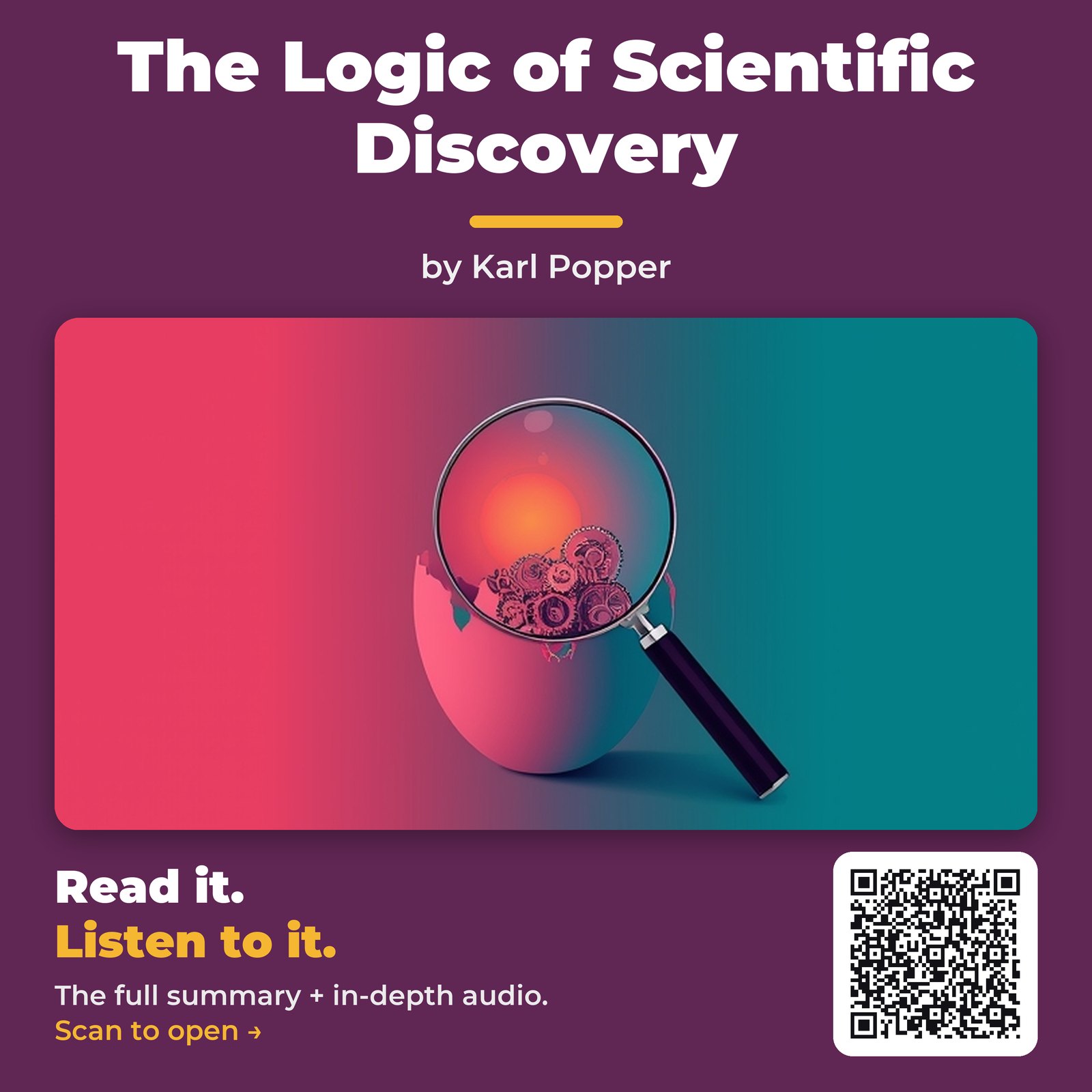
Title: The Logic of Scientific Discovery
Author: Karl Popper
Category: Science & Discovery, Philosophy & Big Ideas, Decision-Making & Critical Thinking, Nature, Climate & Environment
What if science doesn't prove things true at all — it just tries to prove them false? Sam and Sophie open with that question, and it turns out to be the engine of Karl Popper's whole philosophy.
They walk through falsificationism step by step: the problem of induction Hume spotted centuries earlier, why a theory that can explain anything (Freudian psychoanalysis gets a turn) is actually weaker than one that sticks its neck out, and Einstein's 1919 eclipse prediction as the gold standard of a risky, testable claim. The pair also cover Popper's cycle of conjecture and refutation, his theory-laden view of observation, the propensity interpretation of probability, and the political analogue in The Open Society and Its Enemies. Sam pushes back on whether falsificationism is too strict, and Sophie explains Popper's answer.
If you've ever felt uneasy about how confidently people state things, or you want a clearer line between science and pseudo-science, this one's for you. The takeaway: being wrong isn't a failure — it's the whole point.
The Logic of Scientific Discovery by Karl Popper. For the full written summary, head to 7minutebooks.com/app — over 6,000 fiction and nonfiction titles you can read or listen to in any language, plus infographics on many titles. Unlimited access from $2.99 a month, $9.99 a year, or $19.99 lifetime.
Chapters
00:00Falsificationism: Science Tries To Disprove00:35The Problem Of Induction And Black Swans01:26Einstein's Risky Eclipse Prediction02:22Conjecture, Refutation, And Provisional Knowledge03:38Theory-Laden Observation And Critical Rationalism04:11Probability, Politics, And The Pushback
Topics
Related episodes